Nine Stories of the Nine Forms of Goddess Durga or Navdurga
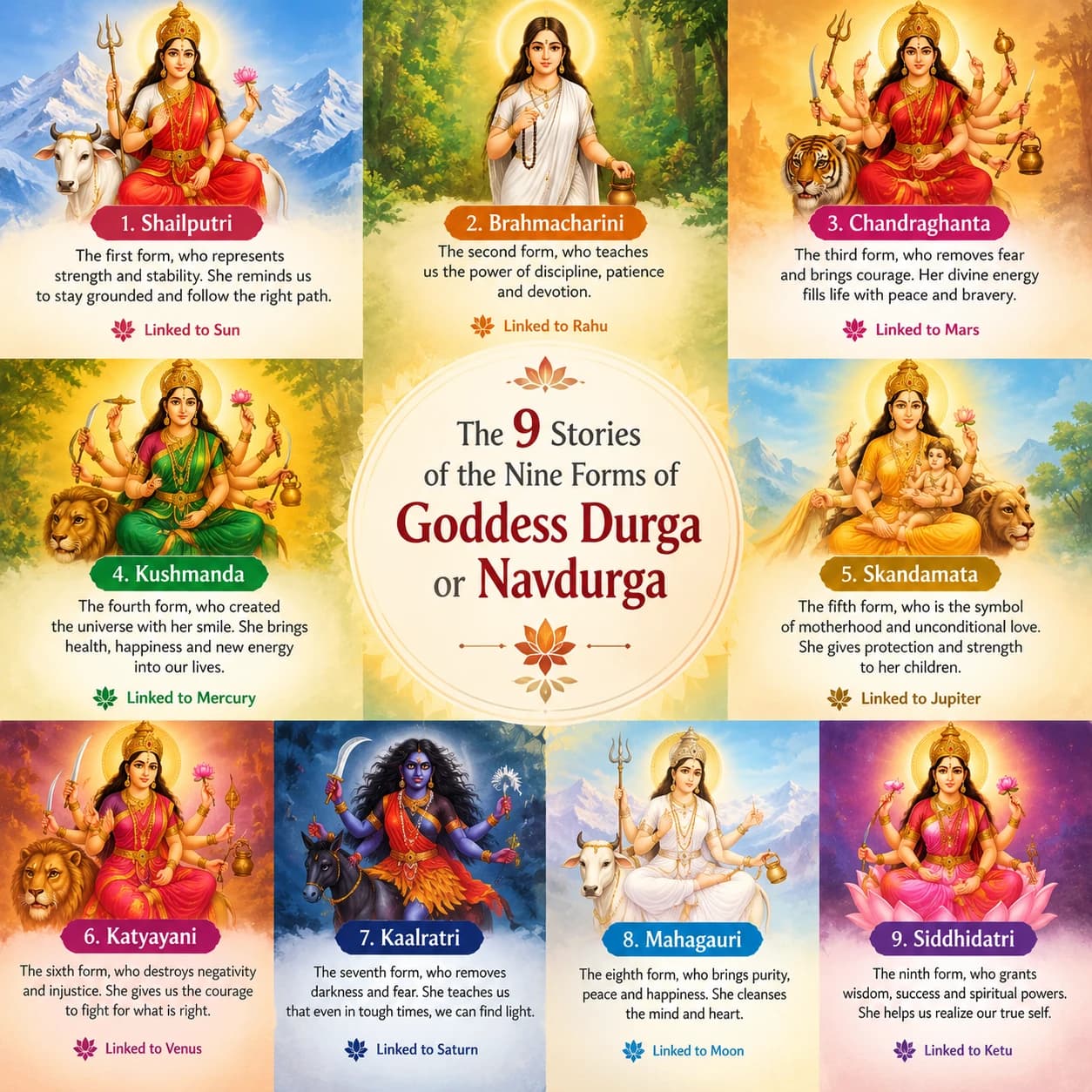
Navratri is one of the most important festivals dedicated to Goddess Durga. During these nine days, devotees worship nine different forms of Maa Durga, together known as Navdurga.
Each form has a different story, appearance, and significance. These stories are not only about battles with demons. They also remind us about strength, patience, devotion, motherhood, courage, purity, and spiritual wisdom.
Let us understand the stories of all nine forms of Navdurga in very simple words.
1. Maa Shailputri – The Daughter of the Mountains
The first form of Maa Durga is Maa Shailputri. The word Shailputri means daughter of the mountain.
According to tradition, Maa Shailputri was born as the daughter of King Himavan, the king of the mountains. In her previous birth, she was Sati, the wife of Lord Shiva. After Sati left her body, she was born again as Parvati, the daughter of the Himalayas.
Parvati later married Lord Shiva and became his divine companion.
Maa Shailputri is shown riding a bull called Nandi. She carries a trident in one hand and a lotus in the other.
Her story reminds us of strength, stability, and determination. Just like a mountain remains firm even during storms, Maa Shailputri represents the strength to remain steady during difficult times.
Message: Stay strong and grounded, even when life becomes difficult.
2. Maa Brahmacharini – The Goddess of Devotion and Penance
The second form is Maa Brahmacharini.
After being born as Parvati, she wished to marry Lord Shiva. But she knew that winning Shiva's heart would require great devotion and determination.
She performed a long and difficult penance. According to the traditional story, she first survived on fruit and later gave up food altogether. She continued her meditation with complete dedication.
Her severe penance finally pleased Lord Shiva, and he accepted her as his wife.
Maa Brahmacharini is usually shown walking barefoot, carrying a rosary in one hand and a water pot in the other.
Her story teaches us that important goals often require patience, discipline, and sincere effort.
Message: True dedication requires patience and self-control.
3. Maa Chandraghanta – The Goddess of Courage
The third form of Navdurga is Maa Chandraghanta.
After her marriage to Lord Shiva, Goddess Parvati came to be known as Chandraghanta because she wears a crescent moon (ghanta) on her forehead.
She is shown riding a tiger or lion and carrying several weapons. Her appearance may look powerful and fierce, but she is also believed to bring peace and protection to her devotees.
According to traditional beliefs, she fought evil forces and protected the gods and devotees from danger.
Her story tells us that courage does not mean having no fear. It means having the strength to face fear when necessary.
Message: Face difficulties with courage, while keeping your mind peaceful.
4. Maa Kushmanda – The Creator of the Universe
The fourth form is Maa Kushmanda.
Her story is connected with the creation of the universe.
According to traditional belief, in the beginning there was darkness everywhere. Then Maa Kushmanda smiled, and her divine energy created light. From this divine energy, the universe came into existence.
This is why Maa Kushmanda is associated with creation, energy, and the source of life.
She is traditionally shown with eight arms and is therefore also known as Ashtabhuja Devi.
Her story reminds us that even a small source of light can remove darkness.
Message: Positive energy and hope can bring light even into difficult situations.
5. Maa Skandamata – The Loving Mother
The fifth form of Maa Durga is Maa Skandamata.
She is the mother of Lord Skanda, another name for Lord Kartikeya.
According to tradition, the gods needed a powerful warrior to defeat the demon Tarakasura. Lord Kartikeya was chosen for this purpose. Maa Skandamata, as his mother, represents the loving and protective power of motherhood.
She is usually shown holding young Kartikeya in her lap while sitting on a lion.
Her story is a beautiful reminder that a mother can be both loving and powerful. She protects her child while also encouraging him to fulfill his purpose.
Message: Love gives strength, and a mother's blessings can give courage.
6. Maa Katyayani – The Warrior Goddess
The sixth form of Navdurga is Maa Katyayani.
Her story is connected with the demon Mahishasura, who had become extremely powerful and troubled the gods and people.
The gods came together and prayed for help. According to tradition, their combined divine energy took the form of Goddess Durga.
Sage Katyayana performed devotion to the Goddess, and she appeared as his daughter. Therefore, she came to be known as Katyayani.
Maa Katyayani fought Mahishasura and eventually defeated him.
Her story represents the victory of divine strength over oppression and injustice.
Message: When we stand against wrongdoing with courage, we can overcome even powerful challenges.
7. Maa Kalaratri – The Fierce Protector
The seventh form is Maa Kalaratri.
She is considered the most fierce form among the Navdurga. She is dark-skinned, her hair is open, and she is traditionally shown riding a donkey.
Her fierce form represents the destruction of negative and evil forces.
In traditional stories, Maa Kalaratri fights powerful demons and protects the gods and devotees from darkness.
Although her appearance may seem frightening, devotees believe that she is a compassionate mother who protects her children.
Her story teaches us an important lesson: sometimes destruction is necessary to remove evil and create space for good.
Message: Do not be afraid of challenges. Face darkness with inner strength.
8. Maa Mahagauri – The Goddess of Purity
The eighth form of Maa Durga is Maa Mahagauri.
The name Mahagauri means extremely fair or pure.
According to tradition, Goddess Parvati performed intense penance for a long time. Because of this, her body became dark and covered with dust.
Lord Shiva later cleansed her with the waters of the Ganga. Her complexion became bright and radiant, and she came to be known as Mahagauri.
She is generally shown wearing white clothes and riding a bull.
Maa Mahagauri represents purity, peace, calmness, and spiritual cleansing.
Her story reminds us that difficult experiences can also lead to inner transformation.
Message: Purity is not only about appearance; it is also about a peaceful and sincere heart.
9. Maa Siddhidatri – The Goddess Who Gives Spiritual Powers
The ninth and final form of Navdurga is Maa Siddhidatri.
The word Siddhidatri means the giver of siddhis, or spiritual accomplishments and divine abilities.
According to traditional belief, Maa Siddhidatri grants devotees who worship her with devotion various spiritual powers and wisdom.
There is also a belief that Lord Shiva received various siddhis through the grace of Maa Siddhidatri. This is connected to the Ardhanarishvara form, in which Shiva and Shakti appear as one divine being.
She represents the completion of spiritual growth.
After moving through the qualities represented by the first eight forms—strength, devotion, courage, creation, motherhood, power, protection and purity—the devotee reaches a state of wisdom and spiritual fulfillment.
Message: The final goal of spiritual life is not just power, but wisdom and inner fulfillment.
What Do the Nine Forms of Navdurga Teach Us?
The nine forms of Maa Durga can also be understood as different qualities that we need in our own lives.
Shailputri | Strength and stability |
Brahmacharini | Devotion and patience |
Chandraghanta | Courage and peace |
Kushmanda | Creation and positive energy |
Skandamata | Love and motherhood |
Katyayani | Courage against injustice |
Kalaratri | Protection and destruction of negativity |
Mahagauri | Purity and peace |
Siddhidatri | Wisdom and spiritual fulfilment |
The Deeper Meaning of Navdurga
The story of Navdurga can be seen as a beautiful journey.
It begins with strength and stability through Maa Shailputri. It then moves towards discipline and devotion through Maa Brahmacharini.
Maa Chandraghanta teaches courage, while Maa Kushmanda represents the creative energy of life.
Maa Skandamata reminds us of unconditional love and motherhood. Maa Katyayani shows the strength needed to stand against injustice.
Maa Kalaratri teaches us not to run away from darkness. Maa Mahagauri represents purification and peace. Finally, Maa Siddhidatri represents wisdom and spiritual fulfillment.
So, Navratri is not only about worshipping nine forms of Goddess Durga. It can also be seen as a reminder to discover these nine qualities within ourselves.
Conclusion
The stories of Navdurga have been passed down through generations. Each Goddess has a unique story, but the message behind them remains simple: have faith, stay courageous, remain patient, protect what is right, and continue your journey towards inner wisdom.
That is perhaps the deeper beauty of Navratri—the celebration of Shakti, the divine feminine energy, and the reminder that strength can take many forms.
Have a question about your own chart?
Ask me one question — written reply within 48 hours.
Have a question about your own chart?